


Trialeti-Vanadzor Culture:
The Trialeti-Vanadzor culture was an indigenous Middle Bronze Age culture that developed in the South Caucasus, especially in parts of present-day southern Georgia and northern Armenia, around the early to mid–2nd millennium BCE. It is generally understood as emerging from local South Caucasian Bronze Age traditions, especially after the decline of the earlier Kura-Araxes culture, rather than appearing as a completely foreign culture. In that sense, the Trialeti-Vanadzor people can be seen as descendants of the older Kura-Araxes cultural world, but with major changes in social organization, burial customs, metalwork, and long-distance connections. They are best known for their rich kurgan burials, finely made bronze and gold objects, decorated pottery, wagons, and evidence of a more hierarchical society led by powerful elites. Their culture also shows wider connections with the steppe world (region above the N. Caucasus), including groups related to the Yamnaya (proto-indo European) horizon, especially through burial traditions and possible movements of people and ideas across the Caucasus. However, the Trialeti-Vanadzor culture was not simply a copy of Yamnaya culture; it was a distinct South Caucasian culture that blended deep local Kura-Araxes roots with outside Yamnaya influences, helping shape the later Bronze Age societies of the Armenian Highlands and surrounding regions. It is also noteworthy that people belonging to this culture were predominantly indo-European, had absorbed local indigenous Kura-Araxes populations, and spoke a proto-Armenian language. This is where the Armenian ethnogenesis began to gradually form.


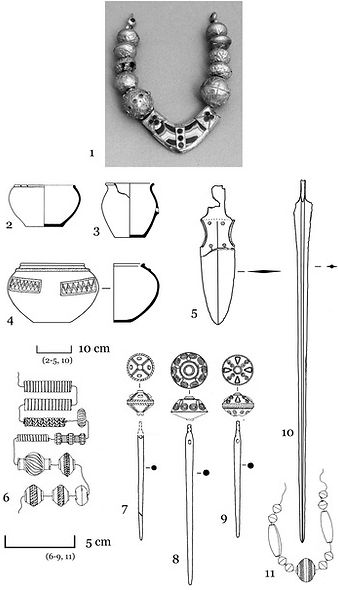


What is the link between modern day Armenians and the Trialeti-Vanadzor culture (simplified)?
- The majority of men from the Trialeti-Vanadzor culture belonged to Z2103, which is a subclade of haplogroup R1b. Approximately 35-38% of modern Armenian men belong to the R1b haplogroup (it is associated with the Yamnaya Culture).
- The majority of women from the Trialeti-Vanadzor culture belonged to Haplogroups U4a, T, HV1a1, and K3, which show continuity from earlier Kura-Araxes and Chalcolithic communities in the Armenian Highlands. Approximately 20% to 28% of the modern Armenian maternal gene pool belongs to haplogroup H and approximately 10% to 14% belongs to haplogroup U, meanwhile haplogroups T and K are far less common.
